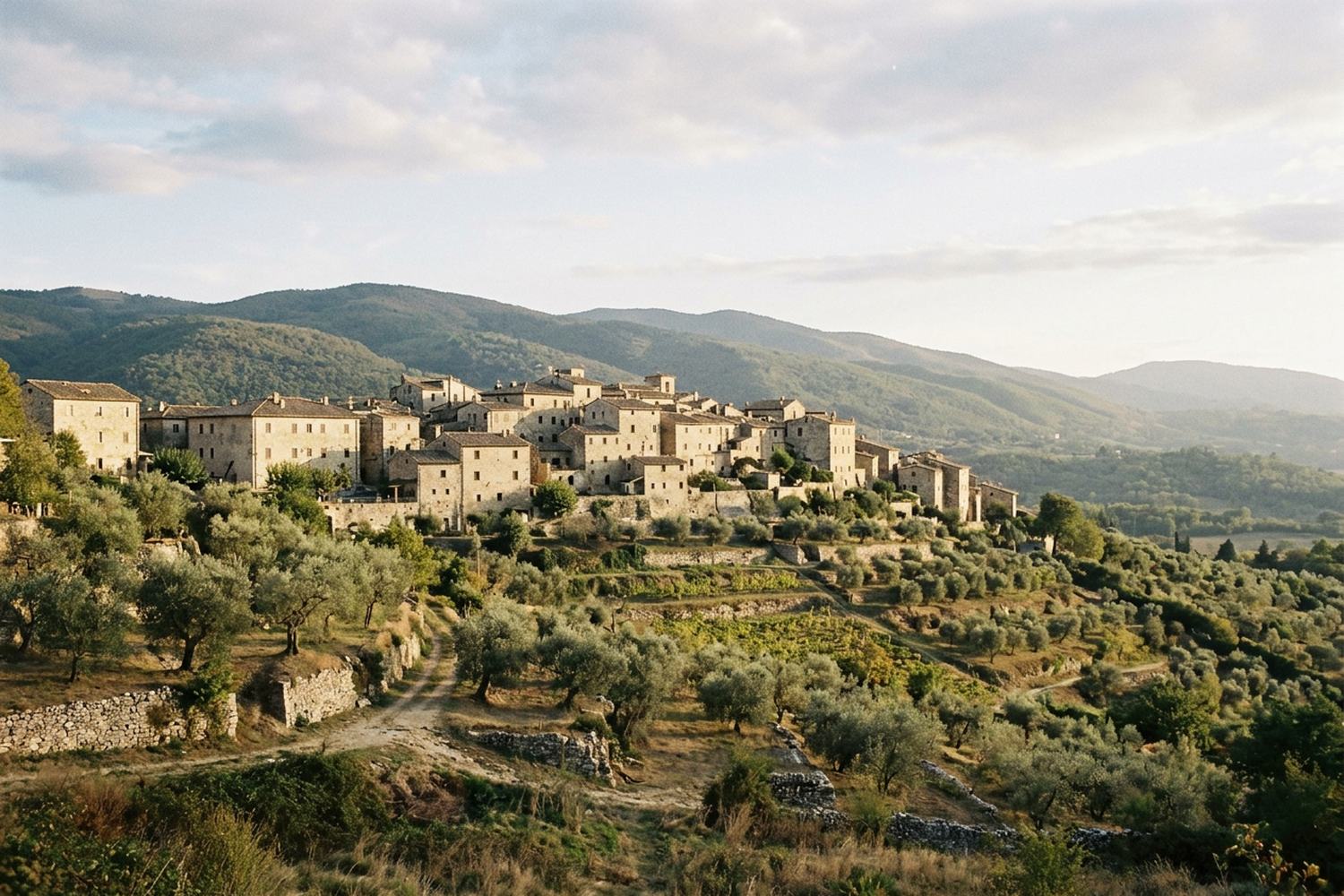
one base | 7 nights | from $1,940 per person
Umbria Vacation Package: Seven Nights, One Hill Town
Seven nights, one room, and a car for four of the days. This Umbria vacation package keeps you in a single hill town and lets the road do the work, from $1,940 per person on two sharing.
What one base means on this trip
Seven nights, one room, one town. The car does the moving and you do not. You wake in the same place on the eighth morning as on the second, and the week is built around driving out and coming back rather than checking out.
- Beds across the trip
- One room for all seven nights, on the second floor of a twelve-room hotel inside the walls of a hill town about 30 minutes from Perugia. You sleep in the same place every night of the week.
- How the bag moves
- Your case goes up the stairs once on arrival and comes down once on departure. For six full days it sits open in the closet and nobody, you included, lifts it anywhere.
- The longest single move
- Rome's main airport to the hotel door, about 2 hours 30 minutes by car with one stop. Nothing else in the week is close: the longest day drive in the route book is 85 minutes each way.
- Time actually spent moving
- Counting both airport runs and four days out in the car, roughly 11 hours of the 168 are spent in a vehicle. That is about one hour in fifteen, and most of it is your choice.
- What stays in the room
- Clothes, chargers and anything breakable stay in the room from Sunday to Sunday. Water, a hat, the car key and your driver's license go out with you every day; the parking permit lives on the windshield all week.
- What the rhythm buys, and what it costs
- You get seven mornings that start identically and a town that knows your face by Thursday. The cost is reach: everything you see sits inside a 90 minute radius, so the coast and the south of the region stay off the list entirely.
- Who this rhythm does not suit
- Anyone who wants four hill towns plus Rome and Florence in one week will be frustrated by this rhythm; the math does not work from a fixed base. It also fails anyone unwilling to drive on narrow roads, since without the car four of the seven days shrink to one town on foot.
The last row loses this desk bookings and it stays on the page anyway. A rhythm that does not suit you is far cheaper to discover here than on the fourth morning.
What the $1,940 pays for
- Seven nights in a twelve-room hotel inside the walls of a hill town, a double room on the valley side, breakfast every morning
- A rental car for four of the seven days, collected in town rather than at the airport, with the resident parking permit arranged before you arrive
- Both airport runs by car, so nobody is driving on the first afternoon or the last
- Two half-day walks with a local guide who works in English: one inside the walls, one through the olive terraces below the town
- A cooking afternoon at a working farm 20 minutes out, four dishes, lunch at the end of it
- A route book of six day drives, none longer than 85 minutes each way, with parking marked for each one
What you pay for on top
- Flights into Italy, which have run $900 to $1,510 per person from Colorado Springs this year and are priced on their own once you name a departure airport
- The three days you keep the car past the four included, about $65 a day, plus fuel and roughly $40 in tolls if you drive the route book in full
- Every meal except the six breakfasts and the farm lunch; dinner in town runs $30 to $45 a head
- A second name on the rental agreement, $12 a day
- Museum and abbey entries, $6 to $14 each, paid at the door
What it costs
from $1,940 per person
- What it covers
- 7 nights, one hill town hotel, a rental car for four days.
- What it assumes
- Two people to a room, unless the seven rows above say otherwise for your case.
- What pushes it up
- Which month you pick, which grade of room, how late you leave it, and how far the beds sit from each other.
- When it hardens
- The day it is written down with an operator named on it. Before that it marks the bottom of a range and claims nothing else.
Settlement happens between you and the operator, on their system. Nothing is collected on these pages and no card reaches this desk.
Which months hold up
May, June and the back half of September are the steady weeks. Daytime sits in the high 70s, the terraces are open, and the roads out of town are empty by 9 in the morning. Early October still holds, with shorter light and a real chance of two wet days in seven.
August is the month to skip. Afternoons reach the mid 90s, the stone gives the heat back until midnight, and the hotel cools the rooms but not the dining room. Half the family kitchens close for two or three weeks, and the ones that stay open are full of people who booked in February. If you ask us for August 8 to 22, we will tell you plainly that the same money buys a better week in late May.
The first half of July is defensible if you accept early starts and a long gap in the middle of the day. March and April cost less for a reason: several of the smaller towns keep winter hours, and an Umbria vacation package that leans on day drives loses its point when four of the six destinations shut at 3 pm.
What is still open when you book
Four things get fixed at confirmation and not before: the room grade, which is a valley window or a courtyard window and a $190 difference across the week; whether the car is collected on day two or day three, which decides how much of the first half is spent on foot; whether the cooking afternoon goes in or is swapped for a second guided walk; and the departure date itself, which moves the flight price more than anything else on this page.